The earliest papers in the scrapbook do not give a polished origin story. They give something better. They show a boy in Buena Park who could be recognized for citizenship, graduate from Primary, get ordained a deacon, hit .424 for the Expos, talk back in P.E., get sent to the principal, draw himself with a beard and a Batman shirt, and later end a school apology with "P.S. I'll try..."
That is a more honest beginning for Steve than any clean legend would be. He was never one thing. Even young, he was already the combination people would know later: tenderhearted, difficult, capable of doing well, capable of making trouble, and always moving.
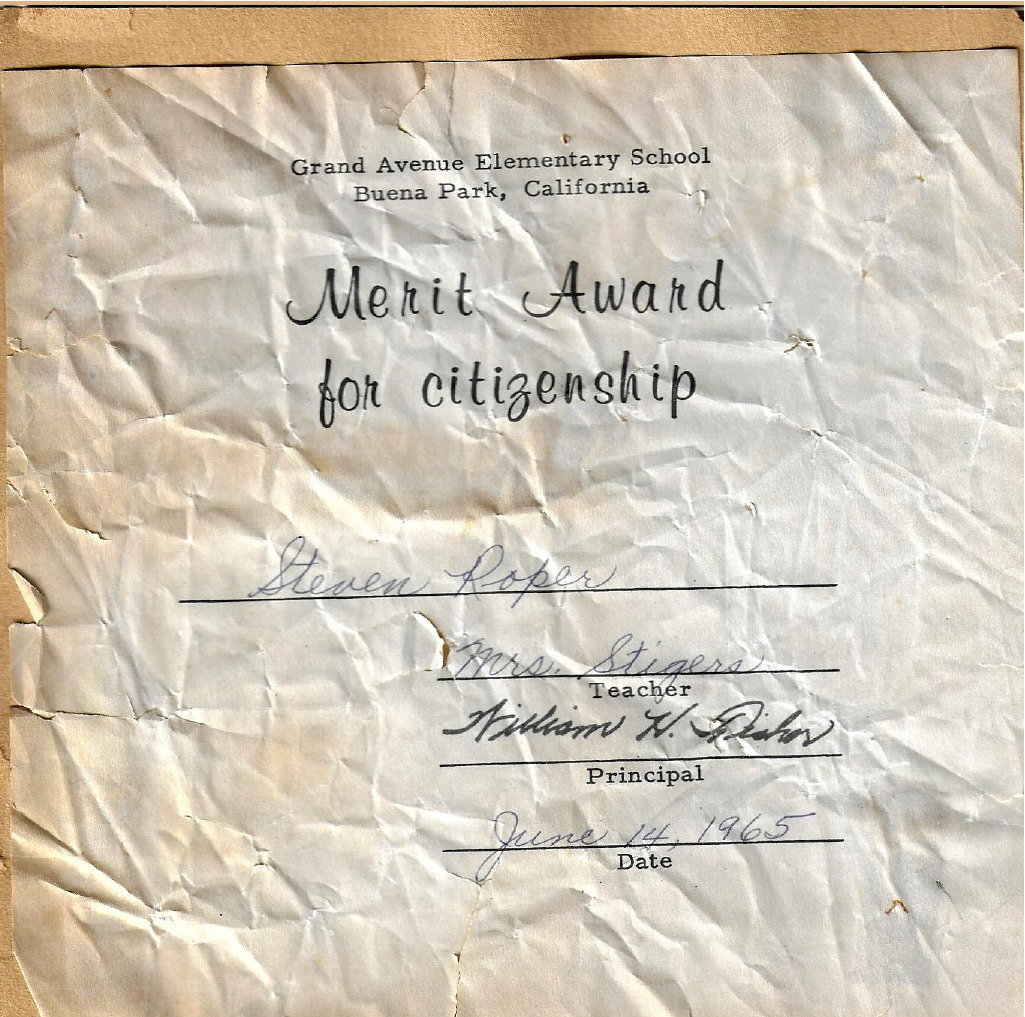
1965 citizenship award from Grand Avenue Elementary.
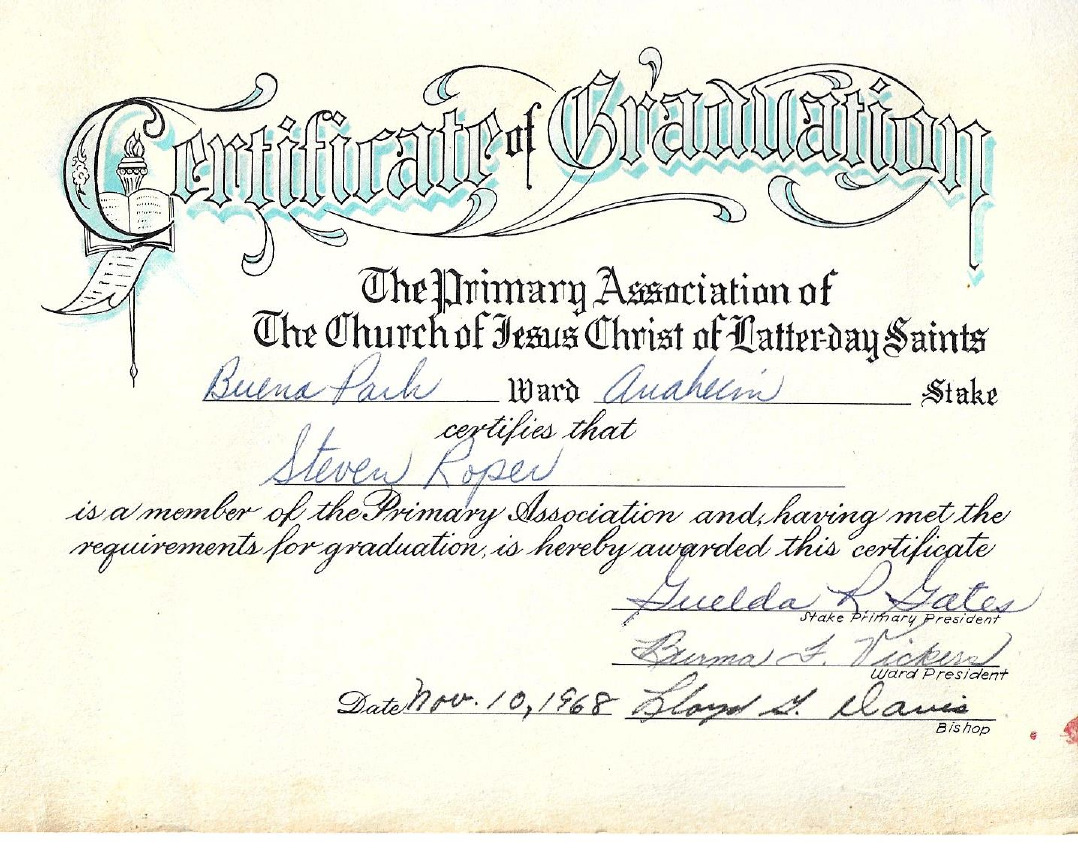
1968 Primary graduation certificate.
"Behavior was much better today. We seem to have opened the door for him. I hope so."
Good on Paper
1965-68
At ten years old he received a merit award for citizenship from Grand Avenue Elementary School. Three years later he graduated from Primary in the Buena Park Ward. Two days after that, on November 12, 1968, he was ordained a deacon in the Buena Park Second Ward. The paperwork from those years makes him look steady and respectable, the kind of kid adults could point to with confidence.
That was part of him. It just was not the whole part. The early records only make sense when you let both things stay true at once: there was a boy who could be recognized for good character, and there was also a boy who had too much motion in him to sit quietly inside anybody else's clean story for very long.
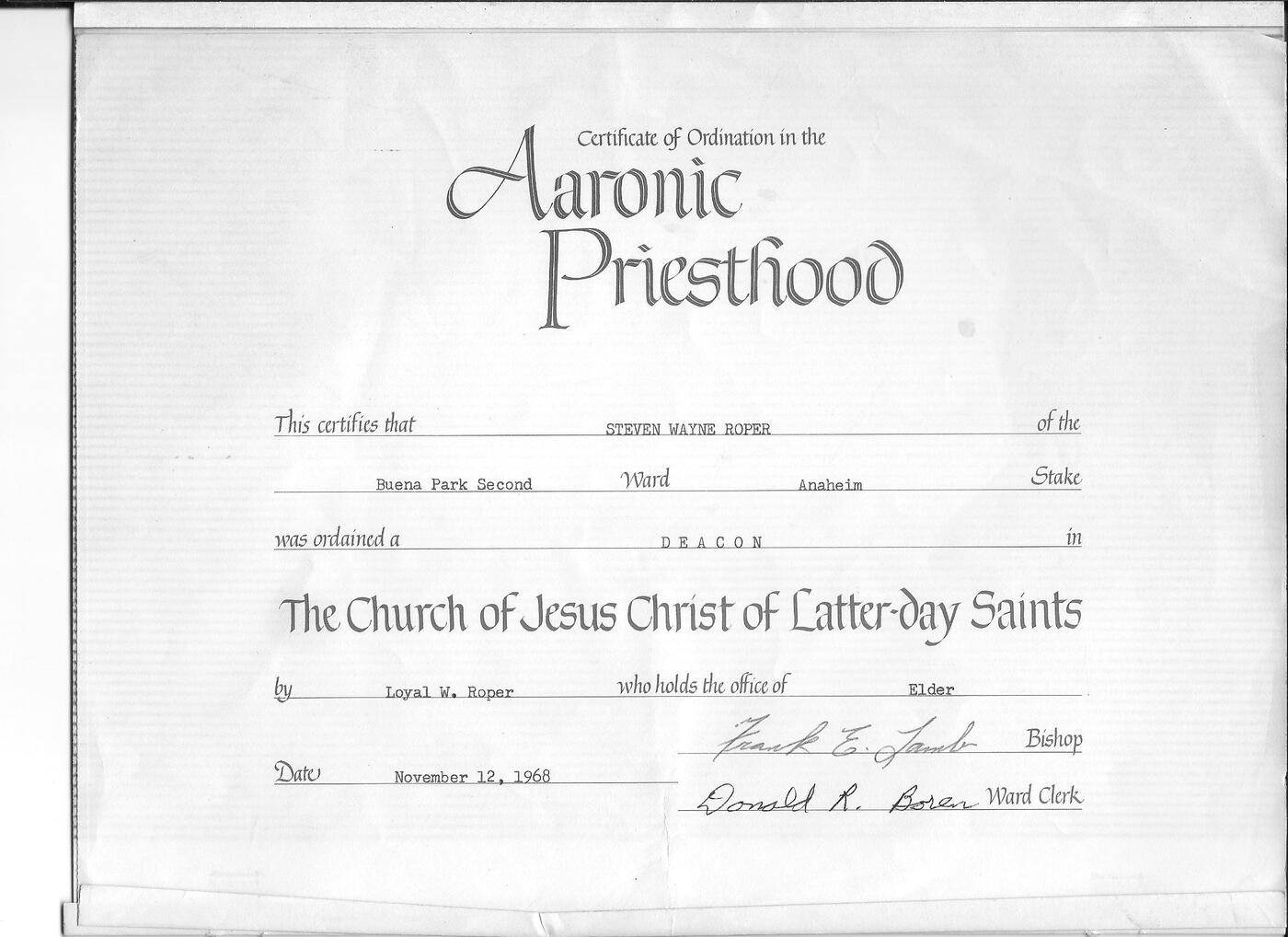
Ordination certificate to the office of deacon, November 12, 1968.
Mr. Snyder's Notes
Sixth grade, 1967-68
The most revealing items from childhood may be the handwritten notes from Mr. Snyder, his sixth-grade teacher, to Steve's mother. They are short, direct, and all over the place in the way real school life is. One note says Steve had no homework and had completed all of his work in class. Another says behavior was much better that day and that maybe they had opened the door for him.
Other notes are less charitable. He had a little trouble during P.E. when he had idle time. He paid a visit to the principal's office for his actions in the classroom and his attitude at the beginning of P.E. His mouth, the teacher wrote, got him in trouble again. None of it reads like cruelty. It reads like adults trying to keep up with a boy who had energy to spare and did not always know where to put it.
That mix matters. Even as a kid he was not cold or shut down. He was in motion. The notes do not describe a bad boy. They describe a boy who kept bumping into the edges of whatever room he was in.
Bobcats and Expos
Summer 1968
Baseball gave that motion somewhere to go. The scrapbook keeps two threads from the same summer. The Bobcats were his team — scrapbook photos from June 1968 show him on second base and rounding the bases after a home run against the Lynx. A separate league clipping lists the top ten batters in the Senior Minor division, where he appears as Steve Roper of the Expos, hitting .424.
He was not just remembered by family stories. He was out there doing something well enough for it to be printed, and someone saved the photos and the clipping both. That little batting list also balances the teacher notes. The same kid who could talk his way into trouble could lead the league with a bat in his hands.
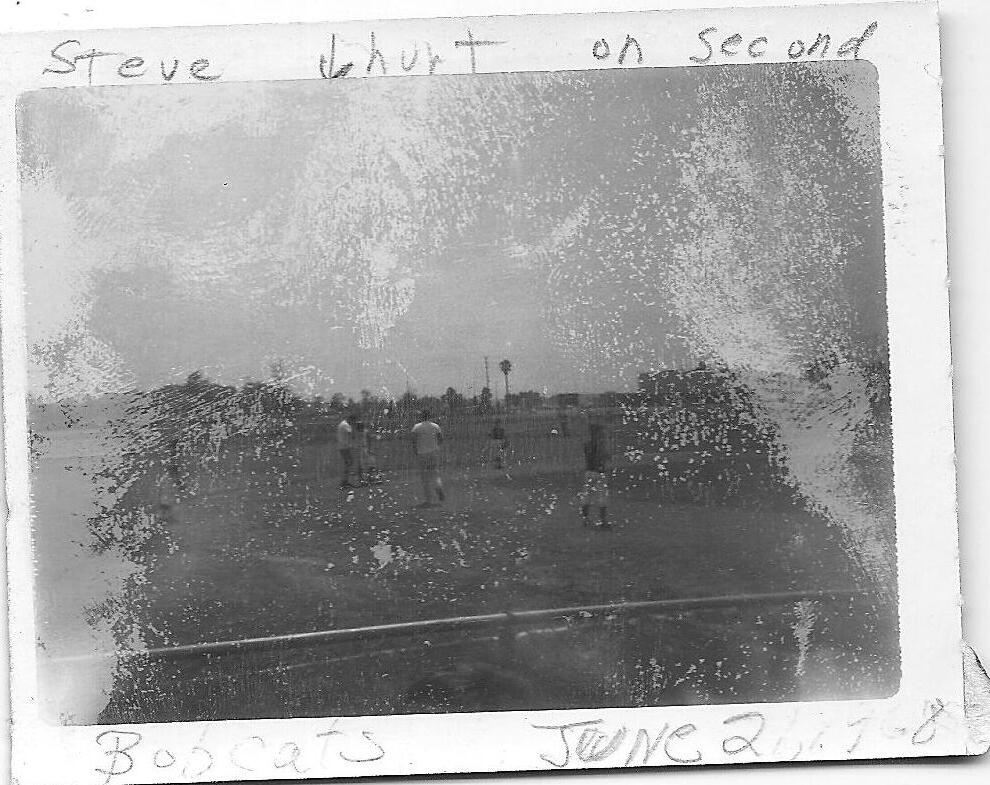
Steve on second base for the Bobcats, June 1968.
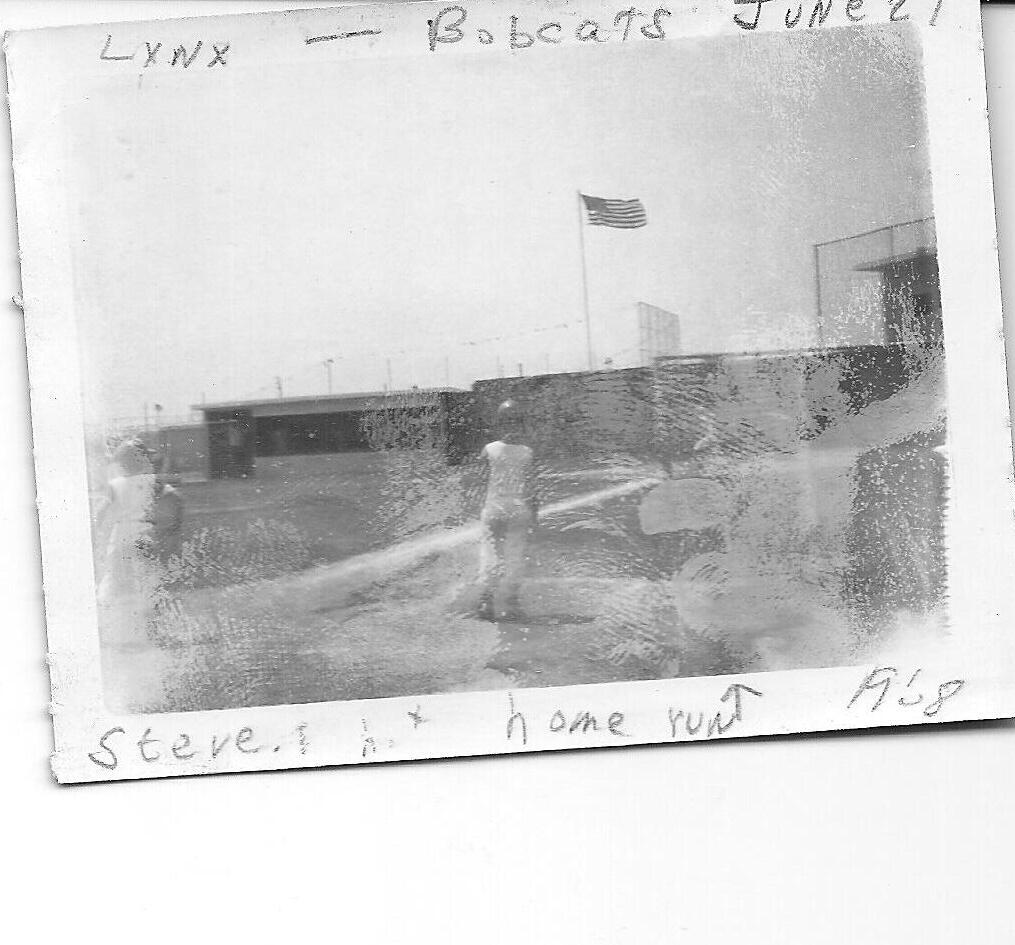
Lynx vs. Bobcats, June 21 — Steve's home run.
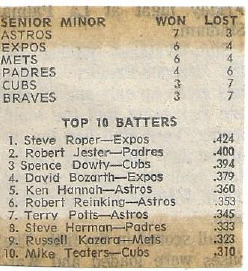
Senior Minor batting leaders — Steve Roper of the Expos, .424.
Thirteen
November 5, 1969
By eighth grade, the records had gotten sharper. A Buena Park School District suspension form lists Steve W. Roper, age thirteen, at Calder School. The report says he was suspended from November 6 through November 13, 1969, and that there had to be a conference before he returned. It is not flattering, which is exactly why it belongs here.
He was not a plaster saint as a boy and nobody should pretend otherwise. The same scrapbook that holds the citizenship award holds the suspension slip. That is not a contradiction. It is the biography. He was tender and difficult at once, and the only thing that changed over the years was the size of the stage.
Within a year he would be writing home from a trout farm in Wyoming at thirteen or fourteen, lonely enough to send a letter every day and proud enough to keep circling around the point before finally saying it. The ingredients were already there.
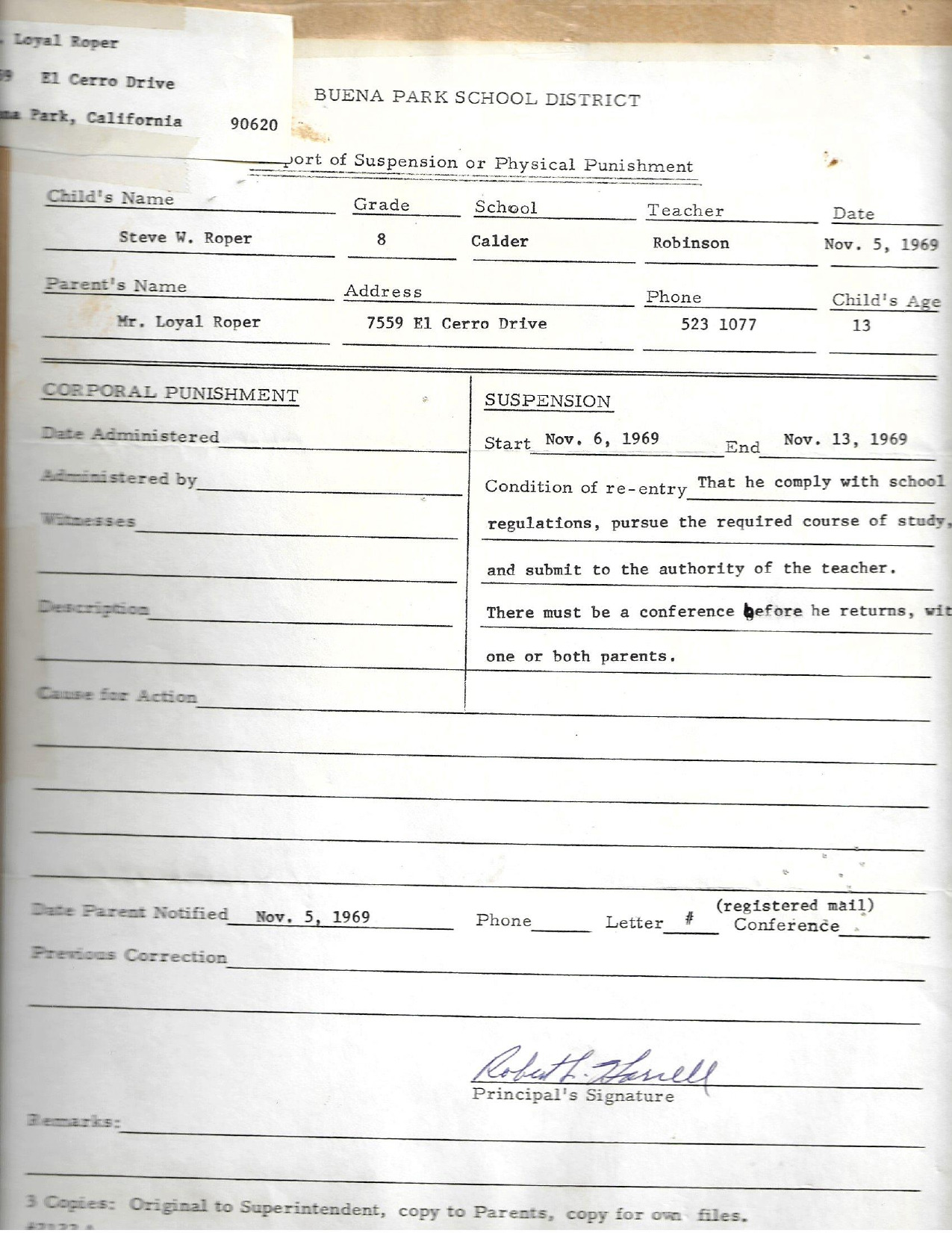
Buena Park School District suspension report, age thirteen, November 5, 1969.
This Is Me In Three Years
Early 1970s
The scrapbook also keeps a teenage self-portrait. He drew himself older, bearded, and wearing a Batman shirt, then wrote, "This is me in three years." It is funny in the offhand way a lot of his better lines were funny. He was not posing for posterity. He was just amusing himself on paper.
That little drawing matters because it shows the same thing the teacher notes and suspension report show from another angle. He already had a strong sense of himself as a character, even if he was still figuring out what kind of man that character would become.
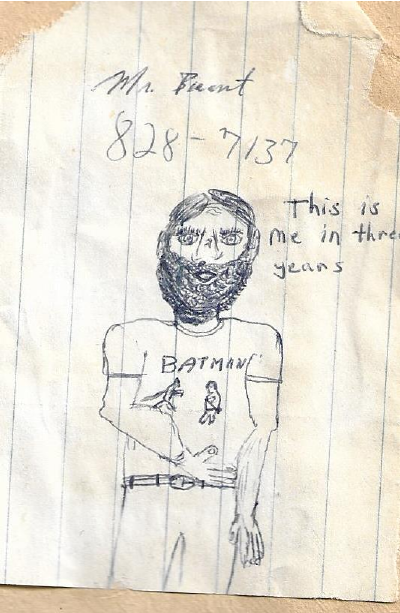
A teenage self-portrait labeled, "This is me in three years."
P.S. I'll Try
1972
By 1972, the papers had shifted from teacher notes about him to a note from him. Writing to Mr. Holms and Mr. Hunnex, Steve said he had been thinking about how he should act in French and how he had actually been acting. He promised to be more respectful, to stop talking unless asked, to raise his grades, and to stop getting up in class without permission.
Then he ended the letter the way a young Steve would: plainly, without trying to sound noble, and with just enough self-knowledge to be believable.
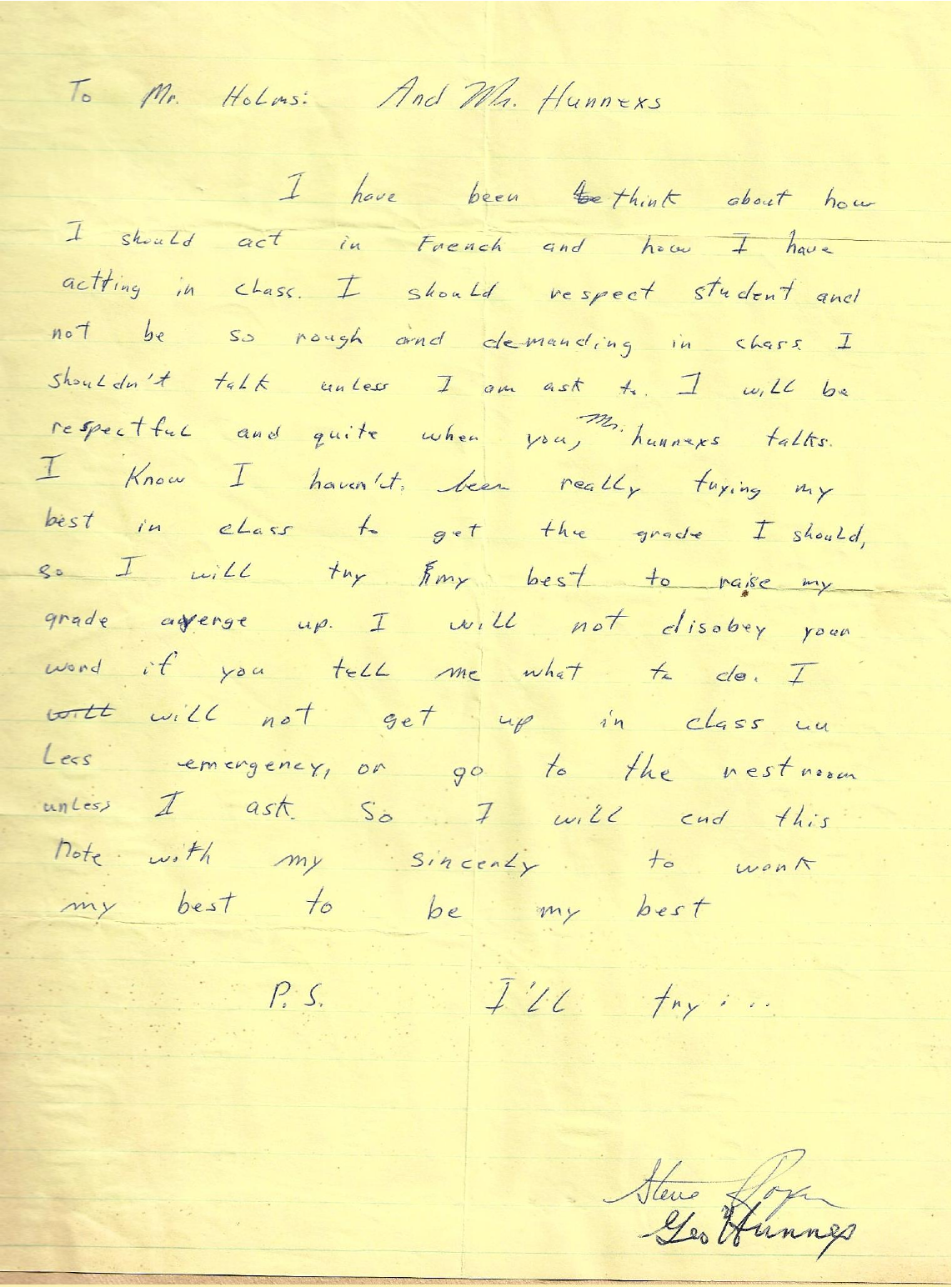
1972 handwritten school apology ending with "P.S. I'll try..."
Sources for this chapter: 1965 merit award for citizenship; 1967-68 sixth-grade notes from Mr. Snyder; 1968 Primary graduation certificate; 1968 deacon ordination certificate; 1968 Senior Minor batting leaders clipping; the November 5, 1969 Buena Park School District suspension report; the early-1970s self-portrait labeled "This is me in three years"; and the 1972 school apology to Mr. Holms and Mr. Hunnex. Click any plate to open the full scan.