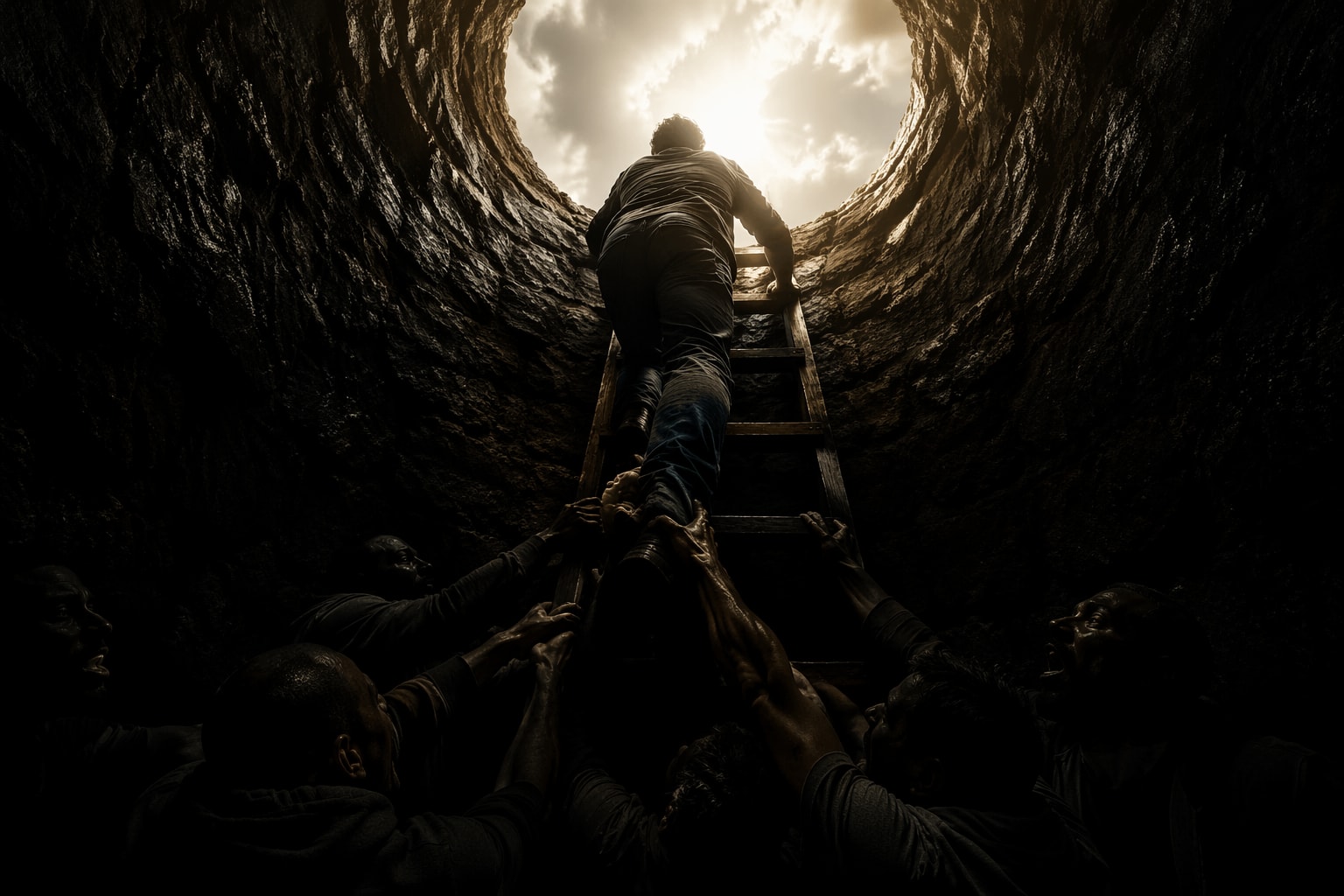
Put crabs in a bucket. Don't bother with a lid — you won't need one. When one starts pulling itself toward the rim, the others grab on. Not coordinated. Not malicious. Just mechanical. The result is the same every time: the one closest to getting out gets dragged back down. Nobody escapes.
People work the same way. No locks. No guards. No ceiling. Escape is possible, and yet almost no one leaves. When one person starts to climb, something predictable happens. Hands reach out. Momentum gets broken. Not always out of malice. Not always with full consciousness. But the effect is the same: movement creates discomfort, so the climber becomes the problem.
What Climbing Forces
When someone rises, it forces a question nobody wants to answer: if they can leave, why am I still here? That question cuts through excuses. It exposes wasted years, choices avoided, and identities built around stagnation. So instead of facing the question, people often eliminate the trigger.
They mock the effort. They question motives. They call it luck, privilege, delusion, or ego. Anything but the simpler admission: I could climb too, but I have not.
"Not everyone wants you to fail. But many people need you not to change."
The Bucket Is Social, Not Structural
The uncomfortable truth is that the bucket is not a prison. There are no chains and no locked door. But the system sustains itself because belonging gets traded for obedience. If you stay, you remain legible to the group. If you climb, you create distance. And distance threatens identity.
Most people do not fear failure as much as they fear isolation. They fear becoming the one who leaves and can no longer pretend the bucket was inevitable. That is why stagnation spreads through agreement more than force. The contract says: stay the same so nobody has to examine themselves too closely.
Climb Anyway
The answer is not bitterness. It is clarity. Do not spend your life fighting every hand that reaches for you. That is part of the trap too. The bucket wants your attention on the pulling, not on the climbing.
Know the difference on the ladder
People who need you to stay where you are because your movement threatens the story they tell themselves.
People who want out too and are willing to take responsibility for their own climb.
Keep moving upward, offer a hand to the reaching, and stop negotiating with the gravity of the crowd.
Climb steady. Climb intentionally. Do not kick the ladder away once you get higher, but do not climb back down just to be accepted either. The point is not to prove you are better than the bucket. The point is to leave it.
I once had a friend who lied to me and chose the bucket. Before I left I told him what I saw: he was a crab in a bucket, and I hoped one day he'd get out. Two years later he came back, apologized for lying, and showed me his arm. He'd gotten a tattoo: a crab standing on top of the bucket, claws raised in triumph. A reminder to never go back in. That's what clarity looks like when it becomes permanent: not a grudge against the people who pulled you down, but a commitment to yourself that you carry on your skin.
The bucket is real. So is the climb. The question is whether you are willing to keep moving when everyone around you would rather stay comfortable together.