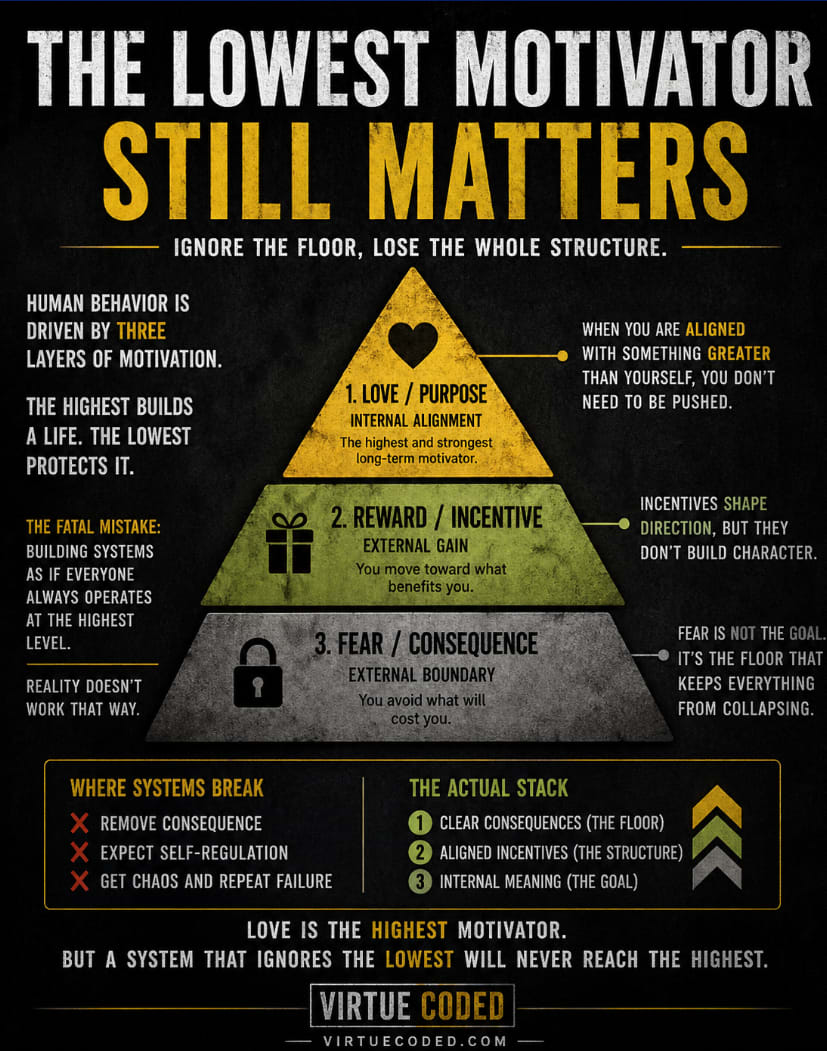
The Three Layers
Every human operates across three motivators:
- Love / purpose — internal alignment
- Reward / incentive — external gain
- Fear / consequence — external boundary
Virtue-coded living builds toward the first. Reality requires all three.
The Fatal Mistake
Modern thinking tries to build systems as if everyone is already operating at the top layer.
They're not.
Not consistently. Not under pressure. Not when tired, angry, addicted, desperate, or unchecked.
So what happens?
You remove consequence — and expect self-regulation.
That's not compassion. That's denial.
The Floor, Not the Goal
Fear is not the ideal motivator. It's the floor.
It's what keeps behavior inside the lines when:
- identity hasn't formed
- discipline isn't stable
- purpose isn't present
You don't build a life on fear. But you also don't remove it and expect order to hold.
Where People Get This Wrong
They confuse aspiration with architecture.
Yes — people should act from love. But systems must account for impulse, weakness, short-term thinking, and self-deception.
If you build for the ideal human, the system collapses under the real one.
Love Without Structure Collapses
Love is powerful. But without structure, it becomes permissiveness, avoidance, rationalization.
Parents know this instinctively. A child raised with only understanding and no boundaries doesn't become free. They become unstable.
Fear Without Meaning Breaks
On the other side: a system built only on fear produces compliance without character, resentment without growth, short-term order with long-term decay.
That's not virtue. That's containment.
The Actual Stack
A functioning human system looks like this:
Clear consequences — the floor
Not the goal. Not the identity. The minimum structure that prevents the worst behavior when love and incentives fail. Remove this layer and the whole stack becomes unstable.
Aligned incentives — the structure
External rewards that pull behavior toward what you actually want. This is the middle layer — reinforcing the right direction when internal alignment isn't enough.
Internal meaning — the goal
Acting because it's aligned with who you are and what you value. This is the target. But it requires the lower layers to exist before it can hold under pressure.
Most people try to skip step one and jump to step three. That works — until it doesn't.
Why This Matters
When the lowest layer disappears: repeat behavior increases, boundaries blur, accountability erodes, trust collapses.
Not because people are evil. Because systems stopped accounting for reality.
"Love is the highest motivator. But a system that ignores the lowest will never reach the highest."
Personal Application
Don't just apply this to society. Apply it to yourself.
Where are you relying on "I should want to" instead of installing constraints that make the right behavior inevitable?
Where are you assuming your highest self will show up — every time?
It won't.
Build accordingly.