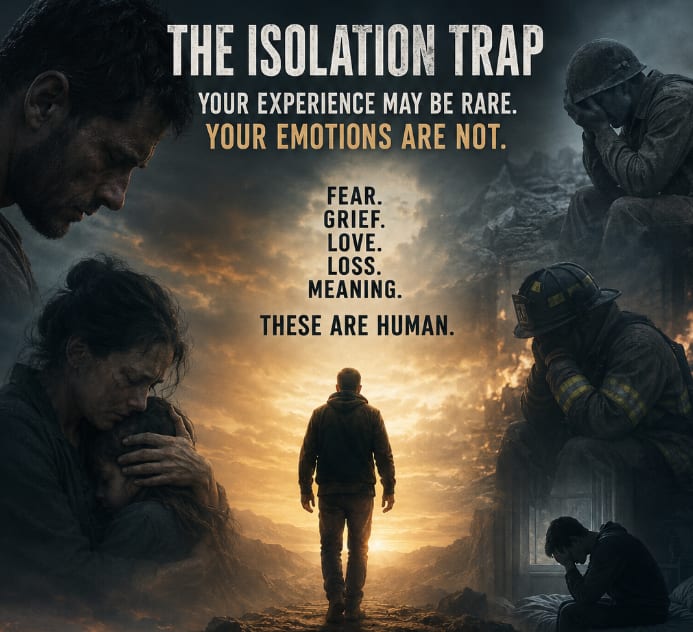
One of the most dangerous lies humans tell themselves is this: no one could possibly understand what I have been through.
Sometimes that belief forms after trauma. Sometimes after loss. Sometimes after betrayal. Sometimes after years of carrying an interior tension that nobody around you seems able to recognize.
At first, the belief feels protective. It creates distance between you and a world that suddenly feels shallow, careless, or unqualified to stand near what happened.
But over time that belief stops protecting you. It starts sealing you off.
Your Experience May Be Rare
Your emotions are not.
A man on a battlefield. A mother losing a child. A firefighter entering a collapsing building. A drowning victim trapped underwater. A lonely teenager spiraling silently at night.
The events are radically different. The nervous system is not.
- Fear
- Helplessness
- Adrenaline
- Grief
- Hyper-vigilance
- Love
- Shame
- Meaning
- Loss
This does not mean all suffering is equivalent. It is not. Magnitude matters. Duration matters. Violence matters.
But emotional relatability is not binary. You do not need identical scars to recognize pain in another human being. If that were false, empathy itself would be impossible.
The Ego Hidden Inside Isolation
Isolation is not always humility. Sometimes it is identity.
Suffering can quietly become a form of self-definition:
- Nobody understands me.
- Nobody feels what I feel.
- Nobody has seen what I have seen.
At that point pain stops being something a person carries. It becomes something they protect.
Because if nobody can understand you, nobody can challenge you either. Nobody can ask whether you are making your pain heavier by curating it, rehearsing it, or building your personality around it.
The isolation becomes self-sealing.
Modern culture reinforces this instinct. Algorithms reward emotional extremity. Social media turns identity into performance. Trauma becomes branding. Alienation becomes aesthetic. People do not always heal their wounds. Often they learn how to display them.
"Pain can deepen connection, or it can become a wall you defend for the rest of your life."
Brotherhood Exists to Prevent Exile
Historically, human beings understood something modern society often forgets: people are not meant to metabolize suffering alone.
That is why civilizations built rituals around grief, violence, shame, and transition. Storytelling. Confession. Funeral rites. Warrior circles. Religious language. Communal mourning. Brotherhood.
Not because ancient people were weak. Because they understood the nervous system.
Pain becomes dangerous when it cannot be translated. Language matters because it lets suffering leave isolation and enter shared humanity. Sometimes healing starts the moment a person realizes: someone else has felt enough of this to stand beside me.
Not identically. But enough.
Partial Understanding Is Still Real
Many people stay trapped because they are searching for perfect empathy. Perfect validation. Perfect emotional translation.
It does not exist.
No human being will ever experience your internal world exactly as you do. But that does not make connection fake. Almost every meaningful relationship is built on partial understanding carried by mutual effort.
Marriage. Friendship. Brotherhood. Parenthood. None require perfect symmetry. They require willingness.
That is the distinction many isolated people miss. They think anything short of complete understanding is a failure. In reality, complete understanding is impossible. The real question is whether someone can recognize enough truth in your pain to remain present without pretending to own it.
The Way Out
The way out of isolation is not pretending your pain is small. And it is not pretending everyone fully understands it.
It is recognizing that suffering belongs to the shared human condition without letting suffering become your entire identity.
The battlefield changes. The human heart changes far less.
If you keep demanding total recognition before you allow connection, you will guarantee permanent loneliness. If you accept that partial understanding is still human, you can re-enter the species without betraying what happened to you.