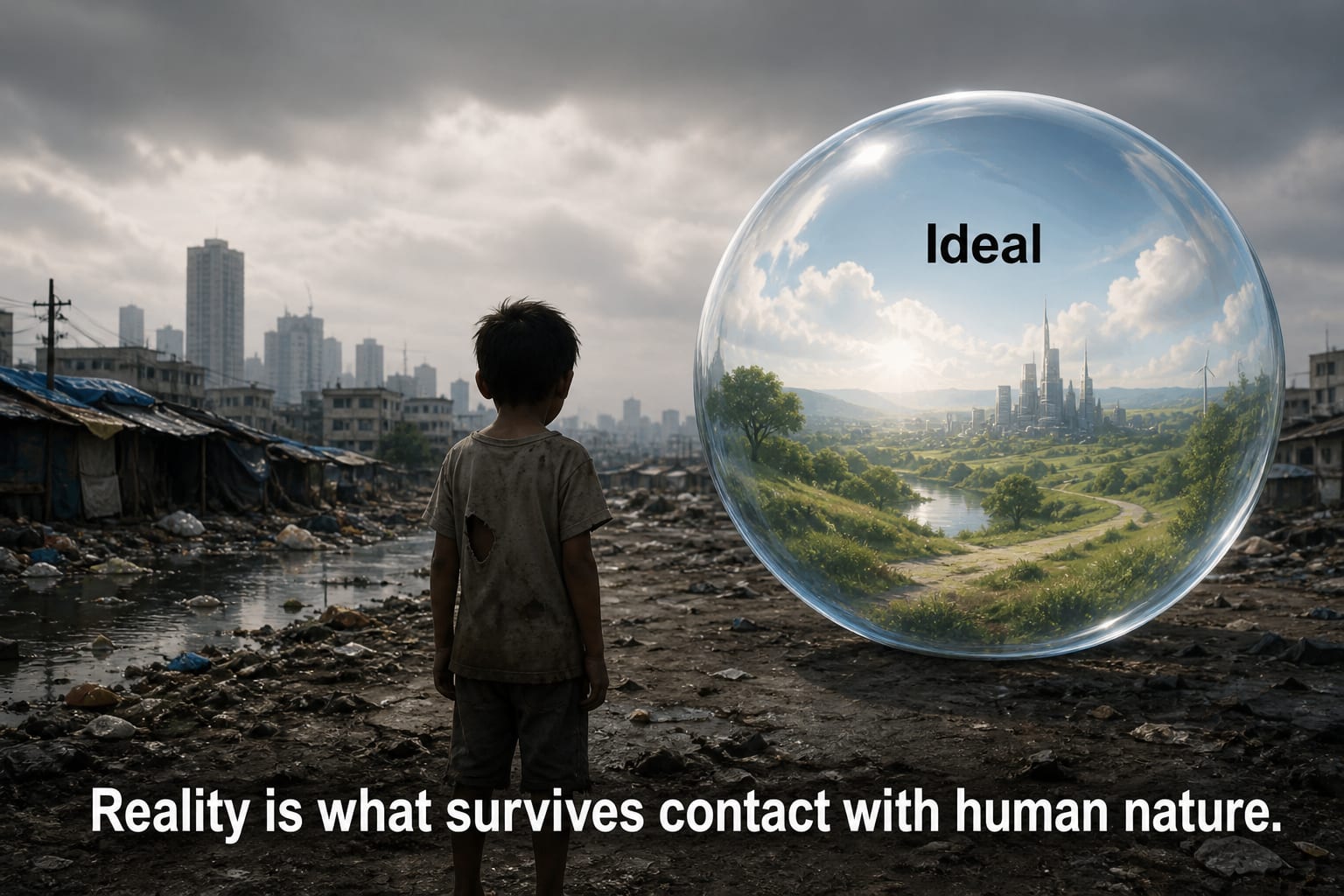
Every generation believes it will build the right system. Every generation runs the same failed experiment. The problem isn't the blueprint — it's the material.
The Seduction of Ideals
Different cultures have produced different versions of this: highly ordered duty-first systems, collective-first societies, honor-based hierarchies, equality-driven revolutions. At face value, many of these are appealing. Discipline. Unity. Shared purpose. None of those are bad concepts.
But concepts aren't systems. And systems aren't reality.
Reality Has Metrics
You don't evaluate a system by how it sounds. You measure outcomes — poverty rates, economic mobility, access to opportunity, corruption levels, stability over time. Run any historical ideal against those metrics at scale, over decades, and the pattern is consistent: the results are worse than the theory.
Take market-driven economics. It's popular to call it the root of every problem. But on the actual metrics — the World Bank estimates global extreme poverty fell from ~36% in 1990 to under 9% by 2020, almost entirely in countries that liberalized trade and markets — nothing else has produced comparable results at scale. Not because markets are clean or fair. Because they handle human inconsistency better than systems that assume people will behave ideally.
It's not competing against perfection. It's competing against everything else humans have tried. The question isn't "is this ideal?" It's "what actually works when you run it through imperfect people for 50 years?"
The Real Problem Isn't the System
This is where most people get it wrong. They argue about systems. The real issue is simpler — and harder to fix:
"Money and power consolidate. Always. It doesn't matter what structure you start with."
Democracy, socialism, monarchy, cooperative models — it doesn't matter. Over time, resources concentrate, influence centralizes, decision-making narrows, and the people holding power start acting in their own interest. Not always immediately. Predictably.
The "Good King" Problem
Even in the most idealized scenario: a perfectly benevolent ruler. Fair. Just. Selfless. It works — for a while. Then that ruler has a successor. Who might be incompetent, or entitled, or corrupt.
You don't need a broken system. You just need one weak link. Over time, you will get one.
Why Ideals Fail at Scale
Ideals can work under specific conditions: small groups, high trust, voluntary participation, shared values, short time horizons. Once you scale beyond that, incentives diverge, accountability weakens, enforcement becomes uneven. The system drifts.
Voluntary small-scale models still function reasonably well precisely because people can leave, standards are enforced socially, and misalignment gets filtered out. The moment participation becomes forced or scaled to millions, the consolidation dynamic kicks back in.
The Only Honest Standard
What works isn't the system that sounds best. It's the system that holds up under pressure — that allows adaptation, distributes opportunity broadly enough, creates incentives for productivity, contains (not eliminates) corruption, and survives bad actors.
You're building systems for imperfect people. Some disciplined, some selfish, some short-sighted, some corrupt. Any model that ignores that will fail. If you come up with something better: prove it, scale it, sustain it over time, show the metrics improving. Then talk about it.
Until then, idealism is just theory. Reality is what survives contact with human nature.