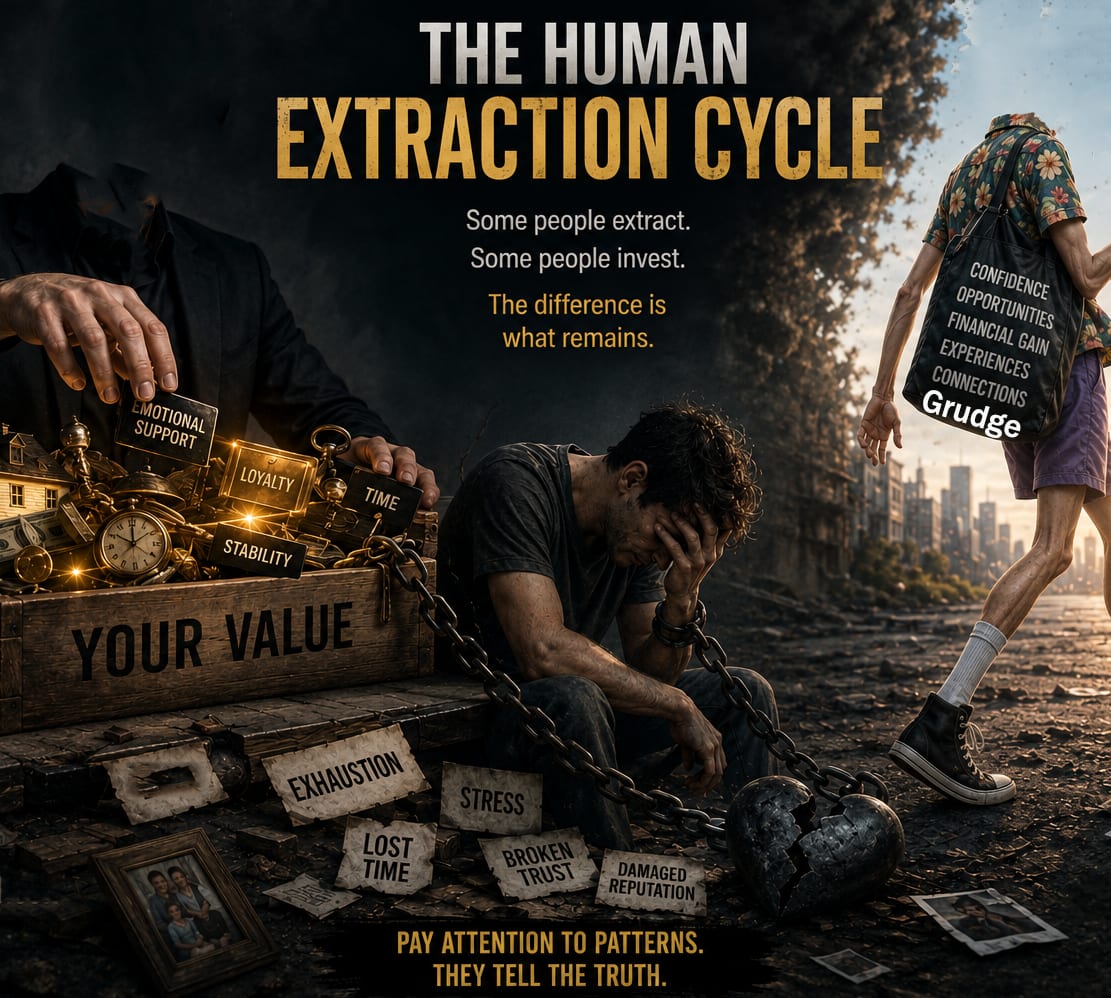
In healthy relationships — personal, business, friendships, even families — both people leave with residual value. Maybe not equally. Maybe not perfectly. But both people are stronger, wiser, more stable, more capable, or more supported because of the relationship.
In extractive relationships, one person leaves upgraded while the other is left carrying the cost.
That's the pattern many people eventually wake up to.
The Extraction Model
Some people approach relationships the same way corporations approach natural resources: extract maximum value, invest minimum value, leave when returns decline, rewrite the narrative afterward.
As long as value is flowing toward them, everything feels stable. You solve problems. You regulate emotions. You provide stability, loyalty, money, labor, opportunities, patience, protection, support, housing, resources, connections, forgiveness, or structure.
And while all of that is happening, they often convince themselves the relationship is "equal" simply because they occasionally contributed something emotionally or situationally.
But the real measurement is not: Did both people contribute something?
The real measurement is: What remains after separation?
That's where reality becomes clear.
Residual Value Reveals the Truth
At the end of many extractive relationships, one side walks away with tangible gains:
- Improved finances
- Improved stability
- Opportunities and experiences
- Confidence and networks
- Lifestyle upgrades
- Years of accumulated benefit
- Debt, exhaustion, stress
- Lost time, damaged reputation
- Legal obligations
- Trauma and reduced trust
- Destroyed momentum
- Responsibilities that continue
That imbalance is what people feel when they say: "I was used." Not because no value was ever exchanged. But because one side built lasting value while the other side consumed it.
The Victim Narrative
What makes these situations even more frustrating is what often happens afterward.
Humans are extremely good at protecting their self-image. Very few people willingly say: I exploited someone. I took more than I gave. I benefited disproportionately. I abandoned the structure someone else built.
Instead, many people unconsciously reconstruct the story in a way that preserves innocence. So the provider becomes controlling, emotionally unavailable, selfish, "not supportive enough," or somehow responsible for the collapse. Meanwhile the extraction itself gets minimized or erased.
This is not always malicious. Often it's psychological self-preservation. Most people cannot emotionally tolerate seeing themselves as the destructive force in a relationship. So the mind rewrites the story until they become justified.
"Rewritten stories do not change objective outcomes."
Human Nature and Incentives
A painful realization many people come to is that incentives matter more than words. People often behave according to what benefits them, what reduces discomfort, what increases security, and what protects identity. Not according to ideals they claim to believe.
This is why boundaries matter. Because without boundaries, highly capable, loyal, patient, or giving people often become targets for extraction rather than appreciation.
- The more responsibility you can carry, the more some people will hand you.
- The more forgiving you are, the more some people will test limits.
- The more stable you are, the more unstable people may lean on you without ever developing stability themselves.
How To Tell If You're the Problem
Before labeling everyone else as selfish, exploitative, narcissistic, fake, or parasitic, there's a brutal question that has to be asked honestly: Am I the unstable force in these relationships?
Because sometimes people really are surrounded by users. And sometimes they are the common denominator. The difference matters.
1. Every Relationship Ends the Same Way
If every ex is "crazy," every friendship "betrayed" you, every business partner was "jealous," every employer was "toxic," and every disagreement becomes proof people are against you — then eventually the pattern deserves inspection.
One or two bad relationships is normal. A lifetime of scorched-earth outcomes usually means something deeper is happening.
2. You Only Value People While They Serve You
Some people confuse control with loyalty. They claim people "changed" the moment boundaries appeared, criticism appeared, accountability appeared, reciprocity was expected, or the other person stopped orbiting them.
If you lose respect for people the second they stop providing emotional supply, validation, attention, labor, or admiration — that's not loyalty. That's consumption.
3. You Escalate Instead of Repair
Healthy people repair relationships. Exploitative or emotionally immature people escalate them. If every conflict turns into punishment, public humiliation, ghosting, revenge, manipulation, smear campaigns, or total severance — you may not actually know how to sustain relationships long term.
4. You Confuse Intensity With Depth
Some people bond fast: "You're my brother. I've never met anyone like you. We're family. I trust you completely." — within days or weeks. That often feels powerful at first. But sustainable relationships are usually built slowly through consistency, reliability, hardship, time, and mutual investment. Fast emotional fusion often burns out just as quickly.
How To Spot Extractive People Early
The harder skill is identifying people who consume relationships instead of building them. Patterns matter more than words.
1. They Have No Long-Term Relationships
Someone over 35–40 talking constantly about loyalty, brotherhood, real people, trust, family, "ride or die" — while somehow having nobody from 10–20 years ago still around — deserves scrutiny. Especially if every old friend was "fake," every former partner was "crazy," every fallout was someone else's fault, and there's a trail of burned relationships behind them.
At some point, the absence of durable relationships becomes evidence. Healthy long-term humans usually accumulate at least a few old friends, respected peers, long-standing clients, stable family ties, or people who quietly vouch for them over decades. Not perfection. Just continuity.
2. They Create Instant "Brotherhood"
Watch for people who push emotional closeness too quickly: calling you family immediately, oversharing early, excessive praise before truly knowing you, intense bonding language, trying to accelerate trust unnaturally. This often creates artificial loyalty before actual character has been tested.
Real brotherhood is usually earned slowly through shared hardship, consistency, reliability, sacrifice, and time. Not speeches.
3. They Consume Stability
Some people are drawn toward stable, capable, responsible individuals because they provide structure, emotional regulation, financial stability, leadership, problem solving, or protection. But instead of growing stronger themselves, they become dependent consumers of that stability.
Over time you realize they need constant rescuing, constant reassurance, constant crisis management, constant emotional labor, or constant external regulation. You become the battery.
4. They Leave Destruction Behind Them
Look at outcomes. Not charisma. Not words. Not image. Outcomes.
Do people around them tend to become stronger, more stable, healthier, more capable, more successful, more peaceful? Or do people around them consistently end up exhausted, financially damaged, isolated, emotionally destroyed, or burned out?
Patterns tell the truth eventually.
5. They Need a Villain
Some people psychologically require someone else to blame for their condition. So there is always an oppressor, a narcissist, a toxic ex, fake friends, jealous people, corrupt bosses, bad luck, society, or betrayal.
Healthy people can acknowledge unfairness without making victimhood their identity. Extractive people often build identity around perpetual grievance because it justifies continued consumption without accountability.
Not Everyone Is Like This
The mistake many people make after experiencing extraction is assuming all humans are parasites. That is not true.
Reciprocal people exist. People who invest back, build with you, protect what you build, communicate honestly, take accountability, and leave things better than they found them.
But reciprocal people usually require standards, boundaries, discernment, patience, and the willingness to walk away early from exploitative dynamics. Many extractive relationships continue not because the warning signs were invisible — but because people ignored them hoping investment would eventually create reciprocity.
It usually does not.
"Being hurt does not automatically make someone wise. Sometimes pain creates wisdom. Sometimes it creates bitterness, paranoia, entitlement, and emotional predation."
The Most Important Distinction
The goal is not becoming cold or isolated. The goal is learning to distinguish reciprocity from extraction, loyalty from dependency, intensity from depth, and real brotherhood from emotional marketing.
Because the older you get, the more obvious something becomes:
People can say "loyalty" all day long.
But the people who actually understand loyalty usually have a trail of long-term relationships that survived reality.