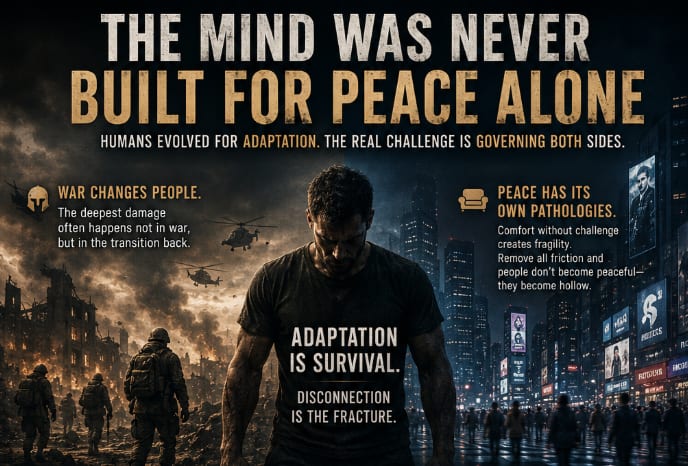
War changes people. Everyone knows that. What fewer people understand is that the deepest fracture often does not happen in war itself. It happens in the transition back.
A human being can adapt to almost anything if he stays inside it long enough. Chaos. Scarcity. Vigilance. Brotherhood. Threat. The nervous system is brutally adaptive.
The real problem appears when the environment changes faster than the mind can.
One day the rules are simple: stay alive, protect your tribe, trust the people beside you, neutralize threats. Then suddenly the task is traffic, email, small talk, and consumer routine as if none of it ever happened.
That is not a mood adjustment. That is an operating-system rewrite.
Humans Are Not Built for War
But we are not built for peace alone either.
Modern people swing between two dishonest extremes:
- Humans are naturally peaceful and war corrupts them.
- Humans are savage killers pretending to be civilized.
Both are incomplete. Human beings are adaptive. We are capable of horrifying violence and profound sacrifice. We build hospitals. We build camps. We raise children. We wage tribal war.
Evolution did not optimize humans for permanent peace. It optimized humans for survival inside unstable environments. That required intense in-group cooperation and readiness for conflict at the same time.
That is why war can create bonds civilian life often cannot replicate. Shared danger compresses meaning. Petty status games disappear. Purpose becomes immediate. The tribe matters again.
The Problem Is Oscillation
Humans can adapt to remarkably different stable worlds: monastic life, frontier hardship, tribal survival, startup chaos, suburbia, prison culture. The nervous system calibrates around repetition.
What breaks people is rapid, unsupported switching between incompatible realities.
Ancient societies understood this better than modern ones. They treated transitions as dangerous. That is why warrior cultures built rituals of decompression, purification, mourning, reintegration, storytelling.
Modern civilization assumes humans are interchangeable. Ancient civilizations knew otherwise.
"The battlefield changes. The nervous system does not."
PTSD Is Not Weakness
If humans were perfectly designed for war, trauma would not exist. The existence of PTSD alone destroys the lazy fantasy that people are naturally built to kill without consequence.
Many soldiers throughout history showed resistance to killing even under threat. Modern militaries had to build conditioning systems specifically to override that hesitation.
Because the average nervous system does not casually absorb human violence.
And when the body survives combat, the moral architecture often does not. PTSD is not only fear. Sometimes it is shattered meaning. Sometimes it is moral injury. Sometimes the wound is: I became someone I do not understand anymore.
Peace Has Its Own Pathologies
Modern society makes a different mistake. It romanticizes comfort.
People living in materially safe environments still feel psychologically hollow because humans also need challenge, responsibility, danger at manageable levels, brotherhood, sacrifice, and earned meaning.
Remove all friction and people do not become peaceful. They become fragile.
That is why so many people unconsciously chase simulated war through outrage politics, online tribalism, social-media combat, ideological extremism, and constant conflict addiction. If meaningful struggle disappears, artificial struggle appears.
The Peaceful Warrior Misunderstanding
The answer is not becoming violent. Nor is it becoming soft.
Modern culture splits into two failures: performative aggression and performative fragility. One mistakes hardness for strength. The other mistakes softness for virtue.
Neither produces stable humans.
The peaceful warrior is not a man without teeth. He is a man with teeth who keeps them under voluntary control.
A harmless person is not the same thing as a disciplined person. Discipline only exists when capacity exists.
Real strength develops competence, restraint, responsibility, emotional control, and calibrated aggression. Not because violence is the goal. Because weakness cannot create peace. Only controlled strength can.
The Real Goal
The goal is not becoming warlike. The goal is becoming capable without becoming consumed.
Strong without domination. Disciplined without rigidity. Protective without cruelty. Calm without passivity.
A nervous system trained for hardship but not addicted to chaos.
Anyone can become soft. Anyone can become hardened. Integrated strength is rarer. Especially in modern culture.