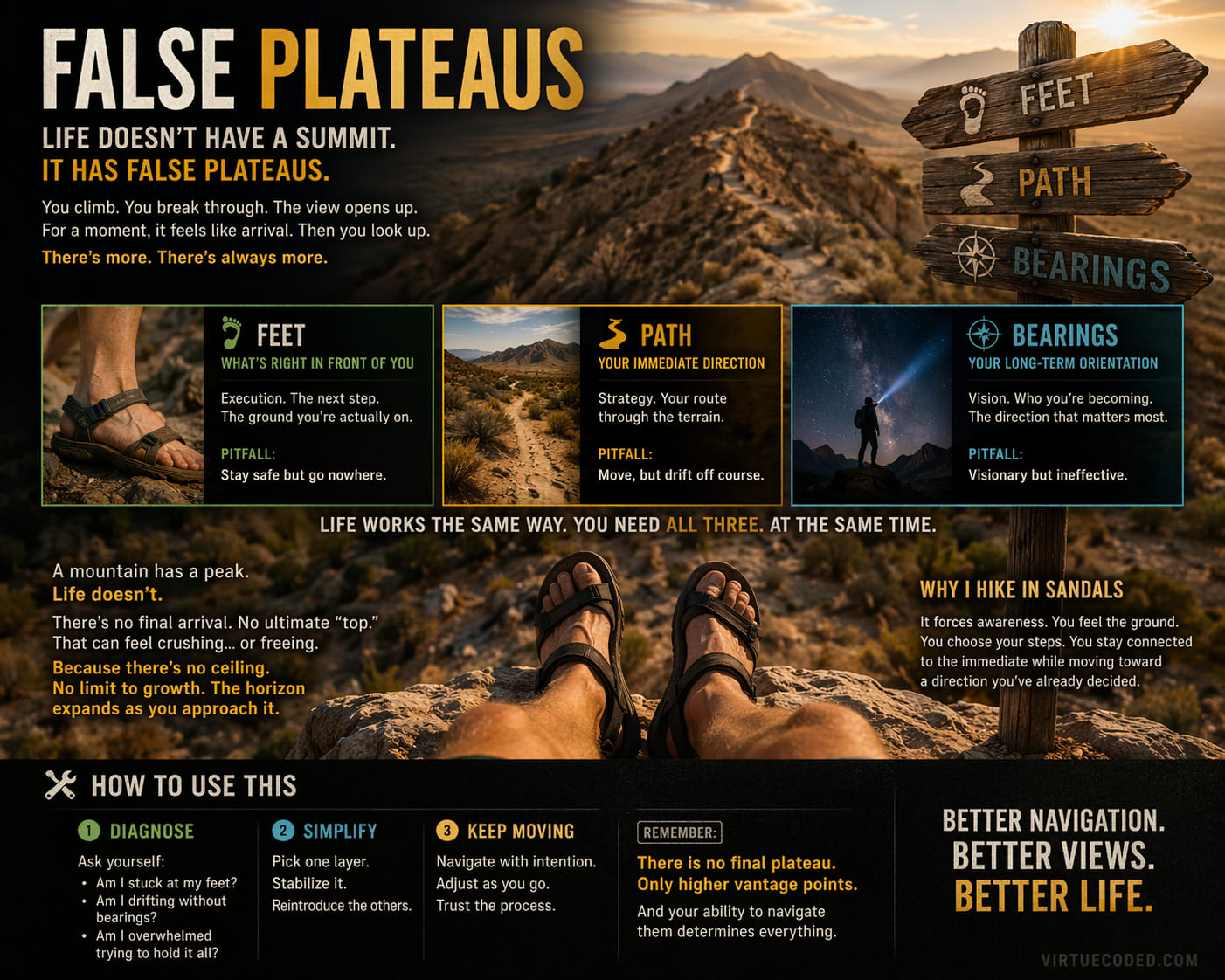
Most people think struggle ends. They assume there is a point where they push hard enough, long enough, and life finally locks in. Then they break through, the view opens up, and for a moment it feels like arrival.
Then they look up and see more mountain. That is the false plateau: the feeling of summiting without the reality of it. Life does not hand out a final peak. It gives you a series of vantage points, each one revealing the next climb.
Why the Plateau Feels Like Failure
Most people experience that moment as discouragement because they were expecting completion. They thought the pressure would lift and the work would end. When it does not, they interpret the next ascent as evidence that the last one did not count.
It counted. It changed your view. It expanded your range. The mistake is expecting growth to end in arrival instead of seeing it as a widening horizon.
Feet, Path, Bearings
The most useful frame here is a three-layer navigation model. In the wilderness, you are always managing the next step, the terrain you are moving through, and the direction you are ultimately pointed. Ignore any layer and you start paying for it.
The three-layer navigation model
Execution. What is directly in front of you. Overused alone, it keeps you safe but leaves you going nowhere with intention.
Strategy. The immediate terrain and short-term direction. Overused alone, it keeps you busy but quietly misaligned.
Direction. The horizon, the destination, the person you are becoming. Overused alone, it turns you into a visionary who keeps walking into obstacles.
Most people do not fail from lack of effort. They fail from navigating on one layer instead of all three. The skill is holding the three layers together with enough rhythm to keep moving without fracturing.
There Is No Final Summit
A mountain has a peak. Life does not. That is the part people keep getting wrong. They treat personal growth like a project with a completion date. They expect a moment where the work pays off, the pressure lifts, and they are finally done.
That moment does not exist. Not because life is cruel, but because the game works differently. Every summit reveals the next range. Every plateau is false in the best sense: it is another point of perspective, not a permanent place to camp.
Diagnose the Layer You Lost
- Depressed: you are stuck at your feet, carrying only the immediate weight of the next step with no usable sense of direction.
- Overwhelmed: you are trying to hold all three layers without rhythm, so everything feels urgent and nothing feels clear.
- Drifting: you are moving without bearings, active enough to look productive while compounding misalignment.
The fix is not mystical. Re-establish the missing layer. If you have lost direction, get your bearings back. If you are drowning in abstraction, collapse down to the next step. If you are busy but off course, stop and triangulate before motion makes the problem expensive.
The Actual Practice
The point is staying connected to the immediate without losing the larger arc. Most people abandon one layer to cope with the others. Real navigation keeps all three in play: feet, path, and bearings. Not once. Every day.
There is no final plateau. There are only higher vantage points and the capacity to keep moving toward them with intention. The horizon expanding in front of you is not proof that you are failing. It is proof that you are still alive in the climb.