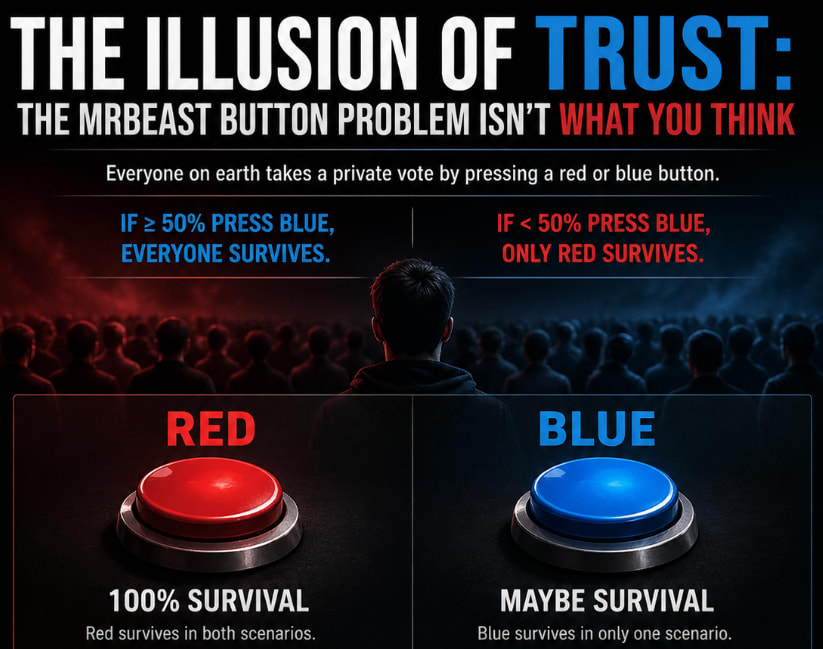
MrBeast asked a question that looked like a morality problem. Everyone treated it like one. That was the mistake.
Everyone presses a button. If 50% or more press blue, everyone survives. If fewer than 50% press blue, only red survives. Which do you press?
Read It Literally
There are only two outcomes:
- ≥ 50% blue → everyone survives
- < 50% blue → only red survives
Now check red:
- If ≥ 50% blue → red survives (everyone survives)
- If < 50% blue → red survives (only red survives)
Red survives in both cases. That's not interpretation. That's the structure.
There Is a Guaranteed Outcome
This isn't trust vs distrust. It isn't cooperation vs selfishness. It's guaranteed survival vs unnecessary risk.
- Survival only if others cooperate
- Best case: everyone lives — same as red
- Worst case: you die
- Zero upside over red
- Survival guaranteed regardless
- Best case: everyone lives
- Worst case: only you survive
- Strictly dominant choice
Blue adds zero upside. In the best case you live — same result as red. In the worst case you die. Red is the only rational choice.
Why the Story Won
Because they didn't answer the system. They answered the story.
People saw a cooperation test. A moral signal. A "faith in humanity" moment. So they picked blue to align with identity, not incentives.
This is the real pattern. People will override clear outcomes when:
- The situation is framed as moral instead of structural
- The "right" answer feels socially desirable
- The risk is abstract instead of immediate
They don't solve the system. They perform inside it.
Trust Isn't the Point Here
This isn't about trusting strangers. Trust implies upside from cooperation. There is none here. Notice: if you're thinking "but I care whether others survive, not just me" — red still gives you that outcome. When ≥50% press blue, everyone lives whether you press red or blue. Your choice of red doesn't change that. What it eliminates is the scenario where you die and everyone else lives anyway. Red dominates even for the altruist.
Calling this a "trust test" is mislabeling the problem — and mislabeling the problem is how smart people make bad decisions.
"When the outcome is clear but people still choose risk, you're not looking at virtue. You're looking at identity overriding reality."
What It Actually Reveals
Not who is good. Not who is selfish. The button reveals who reads systems correctly — and who responds to narratives instead of outcomes.
That distinction matters far beyond a thought experiment. In business, in relationships, in every high-stakes decision: the person who can separate the framing from the structure has a durable edge over the person who can't.
The frame says: "show your virtue." The structure says: "one option is strictly better." The virtue-coded move is to read the structure and act accordingly — not to perform for an audience.